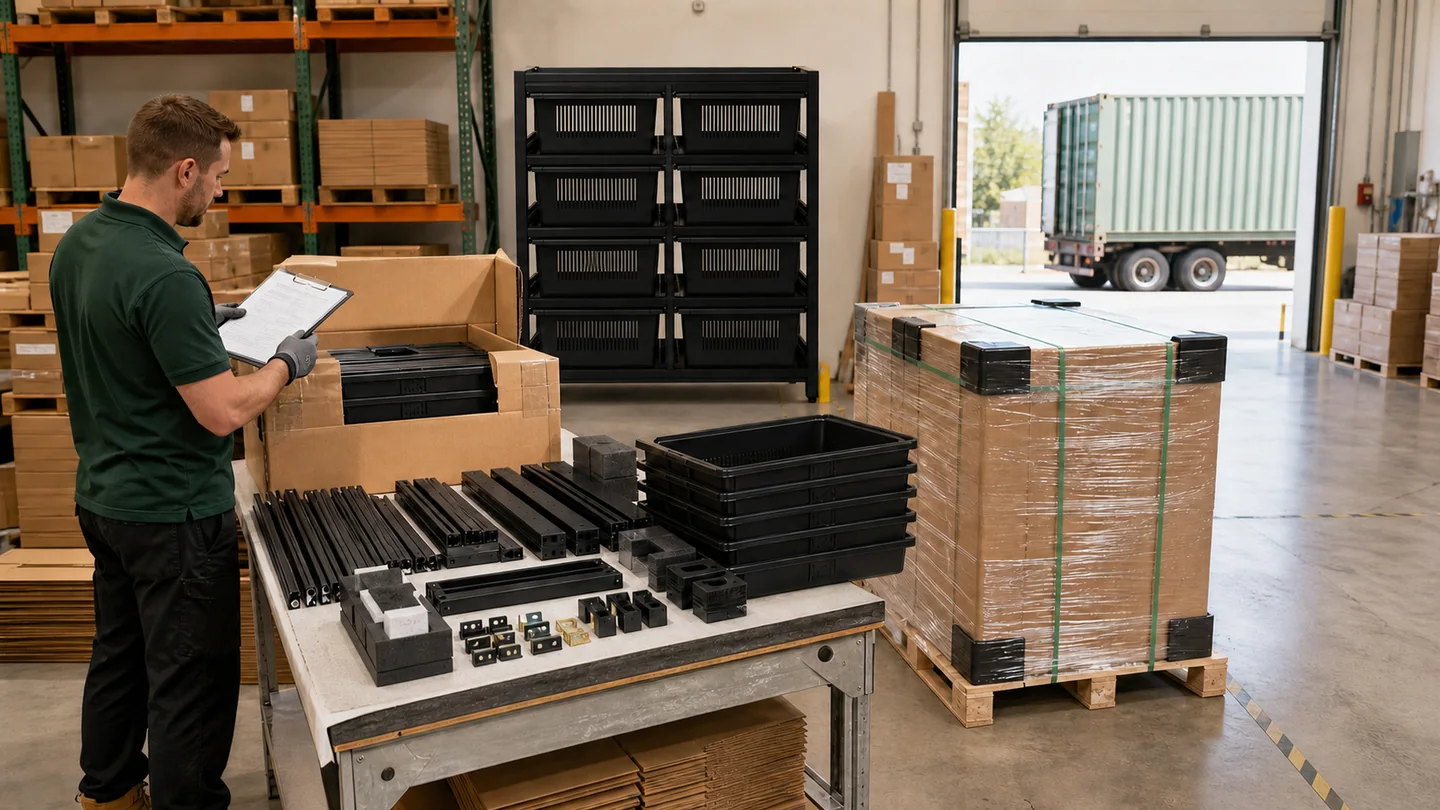
The factory price is only one part of an international reptile rack order. Packaging volume, freight mode, Incoterms, customs documents, destination charges, inspection, and replacement parts all influence the real landed cost and the condition of the shipment on arrival.
Rack systems combine bulky frames, nested tubs, hardware, and sometimes electrical heating components. A shipment that looks simple on a product list can become expensive when carton dimensions, palletization, import rules, or last-mile access are left until the final week. Use this checklist to organize the decisions in the right order.
1. Freeze the Product Configuration First
Freight quotes depend on the actual order. Before asking for a shipping price, confirm model, frame color, tub color, quantity, heating options, voltage, plugs, spare parts, packaging, and any OEM elements. Ask the supplier to identify which parts ship assembled, which ship flat-packed, and whether tubs can be nested.
A final configuration sheet should match the pro forma invoice and purchase order. Late changes can alter carton count, gross weight, cubic volume, and even the documentation required for electrical components.
2. Request a Complete Packing Data Set
Do not plan from product dimensions alone. Request estimated or final:
- carton and pallet count;
- length, width, and height of each package type;
- net and gross weight;
- total cubic meters for sea freight;
- volumetric weight where air or courier service is considered;
- stacking limits and whether pallets can be double-stacked;
- material used for cartons, edge protection, wrap, and internal cushioning.
Compare the packing list to the actual warehouse and receiving conditions. A pallet that fits a container may not fit the destination lift, doorway, dock, or delivery vehicle.
3. Choose the Freight Mode by Landed Cost, Not Habit
For samples and urgent components, courier or air freight may be practical. For wholesale rack orders, sea freight is usually evaluated as less-than-container-load (LCL) or full-container-load (FCL). The cheapest base rate is not always the lowest total.
| Mode | Often considered when | Watch closely |
|---|---|---|
| Courier / express | Samples, documents, small replacement parts | Dimensional weight, restricted components, brokerage and taxes |
| Air freight | Higher-value or time-sensitive partial orders | Volumetric weight, terminal charges, airport-to-door leg |
| LCL sea freight | Trial orders that do not fill a container | Consolidation, extra handling, origin and destination fees, transit variability |
| FCL sea freight | Volume is high enough for container economics | Container loading plan, demurrage, unloading access, inventory carrying cost |
Ask for a door-to-door comparison where possible. A low port-to-port quote can hide destination handling, customs, delivery appointments, liftgate service, or warehouse labor.
4. Put the Incoterm and Named Place in Writing
Incoterms 2020 rules clarify selected obligations, costs, and the point at which delivery and risk transfer between seller and buyer. They do not replace the sales contract, determine payment terms, transfer ownership, or cover every possible issue.
Write the rule, named place or port, and edition clearly—for example, the chosen three-letter term followed by the exact named location and “Incoterms 2020.” Avoid vague wording such as “FOB China” without a named port. The operational question is simple: who books each leg, who handles export and import clearance, who carries risk at each point, and who buys insurance?
5. Align the Document Pack
| Document | What to verify |
|---|---|
| Pro forma invoice / purchase order | Models, quantities, prices, currency, payment milestones, Incoterm, named place, lead time |
| Commercial invoice | Buyer and seller details, accurate description, values, currency, origin, agreed terms |
| Packing list | Package count, marks, contents, dimensions, net/gross weights, total volume |
| Transport document | Bill of lading, sea waybill, or air waybill details match shipment instructions |
| Origin / product documents | Only those required by the destination, tariff program, customer, or product configuration |
| Inspection record | Quantity, finish, dimensions, components, packing, photos, and approved exceptions |
Use precise product descriptions. “Plastic goods” or “metal rack” gives a broker less useful information than a factual description of the product's function, materials, and components.
6. Confirm Classification and Destination Requirements
There may not be one universal tariff classification for a mixed rack order. Frames, tubs, heating plates, and accessories can have different materials and functions. The supplier can provide specifications and a suggested code, but the importer should confirm the final classification and any local standards with a licensed broker or customs authority.
For heating components, confirm voltage, frequency, plug type, labeling, test reports, and any destination-specific electrical requirements before production. Do not assume that a dual-voltage option alone satisfies local market rules.
7. Calculate Landed Cost Before Approving Production
A useful planning formula is:
Product cost + export-side charges + international freight + cargo insurance + duty/tariff + import taxes + brokerage + destination handling + final delivery + receiving labor + expected damage/spares = estimated landed cost.
Allocate landed cost to each SKU using a method that reflects the shipment. For bulky rack systems, volume can be more meaningful than unit count alone. Keep a contingency for currency movement, storage, inspection delays, and destination charges that were not fixed in the initial quote.
8. Use a Pre-Shipment Inspection
Before the balance payment or cargo release milestone, verify a sample of finished goods against the approved specification. A practical inspection can cover:
- model and quantity;
- frame finish and tub color;
- key dimensions and component fit;
- heating option, voltage, and included connectors;
- hardware and spare-part count;
- carton protection, palletization, marks, and packing list;
- photos of loaded pallets or container condition.
Agree in advance how nonconformities will be recorded and resolved. Inspection is most useful when acceptance criteria are objective.
9. Plan Receiving and After-Sales Inventory
Prepare the destination before the truck arrives. Confirm dock access, pallet handling, labor, storage area, count procedure, damage photography, and the deadline for carrier claims. Keep cartons and packing evidence until the incoming inspection is complete.
Include a sensible spare-parts package in the original order: extra tubs, fasteners, connectors, rails, heating components, or other items appropriate to the configuration. The cost of shipping one small replacement internationally can exceed the cost of carrying a spare.
Wholesale Import Checklist
- Product configuration and approved sample are frozen.
- Carton, pallet, weight, and cubic-volume data are confirmed.
- Freight options are compared on total door-to-door cost.
- Incoterm, named place, and Incoterms 2020 edition are written into the contract.
- Broker has reviewed descriptions, classification, and destination requirements.
- Commercial invoice, packing list, transport, and product documents align.
- Pre-shipment inspection criteria are agreed.
- Receiving, claims, storage, and spare-parts plans are ready.
Frequently Asked Questions
Which Incoterm is best for importing reptile rack systems?
There is no single best term. The right rule depends on who can manage export clearance, main carriage, insurance, import clearance, and final delivery. Define the named place precisely and review the choice with your forwarder or trade adviser.
Who confirms the customs classification?
The supplier can provide descriptions, materials, functions, and a suggested classification, but the importer should confirm the final tariff classification and local requirements with a licensed customs broker or the customs authority.
Should a buyer use LCL or FCL sea freight?
Compare total landed cost, shipment volume, routing, handling exposure, timing, and destination charges. LCL can suit smaller trials, while FCL can become more efficient and reduce handling when volume is high enough.
Trade reference: International Chamber of Commerce — what Incoterms 2020 rules do and do not cover.