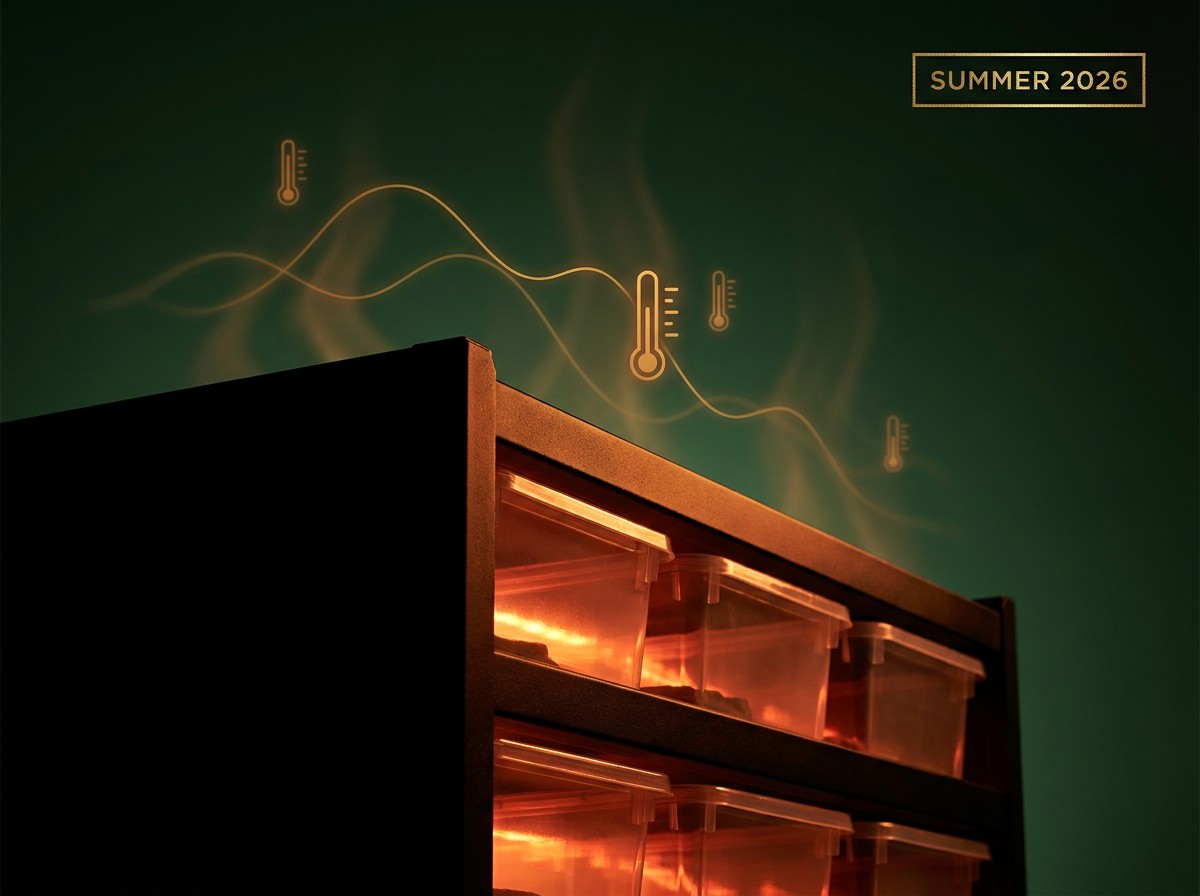
Reptile rack heating is one of the most critical — and most misunderstood — aspects of professional reptile husbandry. Get it right and your animals thrive, your breeding pairs ovulate on schedule, and your eggs hatch with consistent ratios. Get it wrong and you end up with thermal burns, failed clutches, or worst case, dead animals. This 2026 guide walks you through every essential reptile rack heating decision so you can set up your facility with confidence.
Why Heating Strategy Matters More Than You Think
Reptiles are ectothermic, meaning they regulate body temperature by moving between warm and cool zones. In the wild, they bask in the sun, retreat to shade, burrow underground. In a reptile rack system, you have to recreate this thermal gradient artificially using heating elements positioned underneath or behind each tub.
The goal is not to keep the entire enclosure warm. The goal is to create a thermal gradient — a warm side (typically 88-92°F / 31-33°C for tropical species) and a cool side (75-80°F / 24-27°C) within each tub, so the animal can thermoregulate naturally.
This is the foundation of every reptile rack heating decision: gradient, not uniform heat.
Heat Tape vs Heat Plate: Which Should You Choose?
There are two main heating approaches used in modern reptile rack systems:
Heat tape — Flexible flat resistance-wire ribbon, typically 11" or 18" wide, runs along the back or under each tier of the rack. Lower upfront cost but requires wiring and a thermostat for safety.
Heat plates — Pre-fabricated heating panels with built-in anti-static coating and standardized dimensions matched to specific rack models. Higher upfront cost but plug-and-play installation with consistent heat distribution.
For professional reptile breeding facilities running 10+ racks, heat plates are typically the better long-term investment because:
- Consistent dimensional matching means no exposed wires
- Anti-static coating prevents substrate sticking and reduces fire risk
- Standardized wattage simplifies thermostat sizing
- Plug-and-play means faster facility setup and easier replacement
For hobbyists running 1-3 racks, properly installed heat tape with a quality thermostat can work fine if you are comfortable with basic wiring.
Heating Plate Wattage by Rack Size
Matching heating wattage to rack size is essential. Too little wattage and you cannot reach target temperatures in cool rooms; too much and you risk thermal runaway. Here are recommended wattages for common rack configurations:
Small format racks (45-Series M, A4P, R4): - 46.8W heating plate, dimensions ~760×150mm - Suitable for 590-870mm rack widths - Powers a 4-6 tier rack
Medium format racks (45-Series L, NS6030, NS6045): - 81W heating plate, dimensions ~920×200mm - Suitable for 870-1100mm rack widths - Powers a 6-8 tier rack
Large format racks (4560 L, NS6090, R4L): - 122W heating plate, dimensions ~1255×180mm - Suitable for 1100-1300mm rack widths - Powers a 8-10 tier rack
Always oversize slightly if your facility room temperature drops below 70°F (21°C) in winter — heating plates work harder in cold rooms.
Target Temperatures by Species
Different reptile species require different rack heating setups. Here are 2026 best-practice target temperatures for common species kept in rack systems:
Ball Pythons (Python regius) - Warm side: 88-92°F (31-33°C) - Cool side: 78-82°F (25-28°C) - Night drop: optional, 5°F (3°C) acceptable
Corn Snakes (Pantherophis guttatus) - Warm side: 85-88°F (29-31°C) - Cool side: 72-78°F (22-26°C) - Night drop: helpful, 8-10°F (5-6°C) recommended
Boa Constrictors (Boa imperator) - Warm side: 88-92°F (31-33°C) - Cool side: 78-82°F (25-28°C) - Higher humidity required than pythons
Carpet Pythons (Morelia spilota) - Warm side: 88-90°F (31-32°C) - Cool side: 75-78°F (24-26°C) - Night drop helpful for breeding
Leopard Geckos (Eublepharis macularius) - Warm side: 88-92°F (31-33°C) - Cool side: 70-75°F (21-24°C) - Lower humidity required
Always verify temperatures with a digital probe thermometer placed on the warm side floor, not an analog dial gauge mounted to the wall.
Thermostat: Non-Negotiable
Never, ever run reptile rack heating without a thermostat. A failed heating plate without thermostat control can reach 200°F+ (93°C+) within minutes, killing every animal in the rack.
The two thermostat types used in professional rack heating:
Pulse Proportional Thermostats (recommended for snakes) - Rapidly pulses power on and off to maintain temperature - Best for under-tank or back-mounted heat sources - Quiet, no clicking sounds - Examples: Herpstat, VE-300, Microclimate B1ME
Dimming Thermostats - Gradually dims power like a light dimmer - Best for visible light bulbs (less common in rack systems) - Can extend bulb life
For most reptile rack heating, a pulse proportional thermostat is the right choice. Budget for one quality thermostat per rack column — it pays for itself the first time it prevents a heating failure.
Common Reptile Rack Heating Mistakes
After working with thousands of breeders globally, these are the most common heating setup mistakes we see:
1. No probe verification — Trusting the thermostat display without verifying with a calibrated digital thermometer. Always cross-check.
2. Probe placement too far from heat source — The thermostat probe should sit on the floor of the warmest tub, directly above the heating plate. Not in the middle of the rack, not on a cool tier.
3. Uniform heat across the entire rack — Every tier should have its own gradient. If your heat plate runs the full back of the rack at one wattage, you lose the gradient.
4. Skipping thermostat backup — Single point of failure. Premium facilities run a primary pulse thermostat plus a secondary high-temperature cut-off safety thermostat.
5. Ignoring ambient room temperature — A reptile rack in a 60°F (15°C) garage needs different wattage than one in a 75°F (24°C) climate-controlled facility.
6. Wrong heating element on PVC tubs — Some plastic tubs warp at sustained temperatures above 95°F (35°C). PET tubs handle higher temperatures, which is why we use them exclusively.
Voltage Considerations for International Buyers
If you are buying reptile rack heating for international shipping, voltage matters. Stellar Start can coordinate model-matched 110V / 220V heating plate options for different destination markets, including:
- 110V regions: USA, Canada, Mexico, Taiwan, parts of South America
- 220V regions: Europe, UK, China, Australia, most of Asia and Africa
Always confirm voltage compatibility before ordering — running a 110V heat plate on 220V will destroy it instantly.
Heating Setup Checklist
Before powering on your reptile rack heating, verify:
- ☑ Heating plate matches rack model dimensions
- ☑ Thermostat installed and probe placed on warm side floor
- ☑ Anti-static coating intact (no scratches or peeling)
- ☑ Voltage matches your regional power
- ☑ Digital thermometer cross-verifies temperatures
- ☑ Safety cut-off thermostat installed as backup
- ☑ All wiring secured and out of animal reach
- ☑ Tested for 24 hours empty before introducing animals
Final Thoughts
Reptile rack heating is not glamorous, but it determines whether your facility succeeds or struggles. Professional breeders who invest in matched heating plates, quality thermostats, and proper probe placement see consistent breeding results year after year. Hobbyists who cut corners on heating end up with thermal burns and failed clutches.
If you are setting up a new facility or upgrading your existing reptile rack heating, match your heating plates to your rack model, use a quality pulse proportional thermostat, and verify every temperature with a probe thermometer.
Need help selecting the right heating configuration for your reptile rack system? Our team can recommend exact wattages based on your room temperature, rack size, and target species. Reach out anytime via the contact form or WhatsApp.