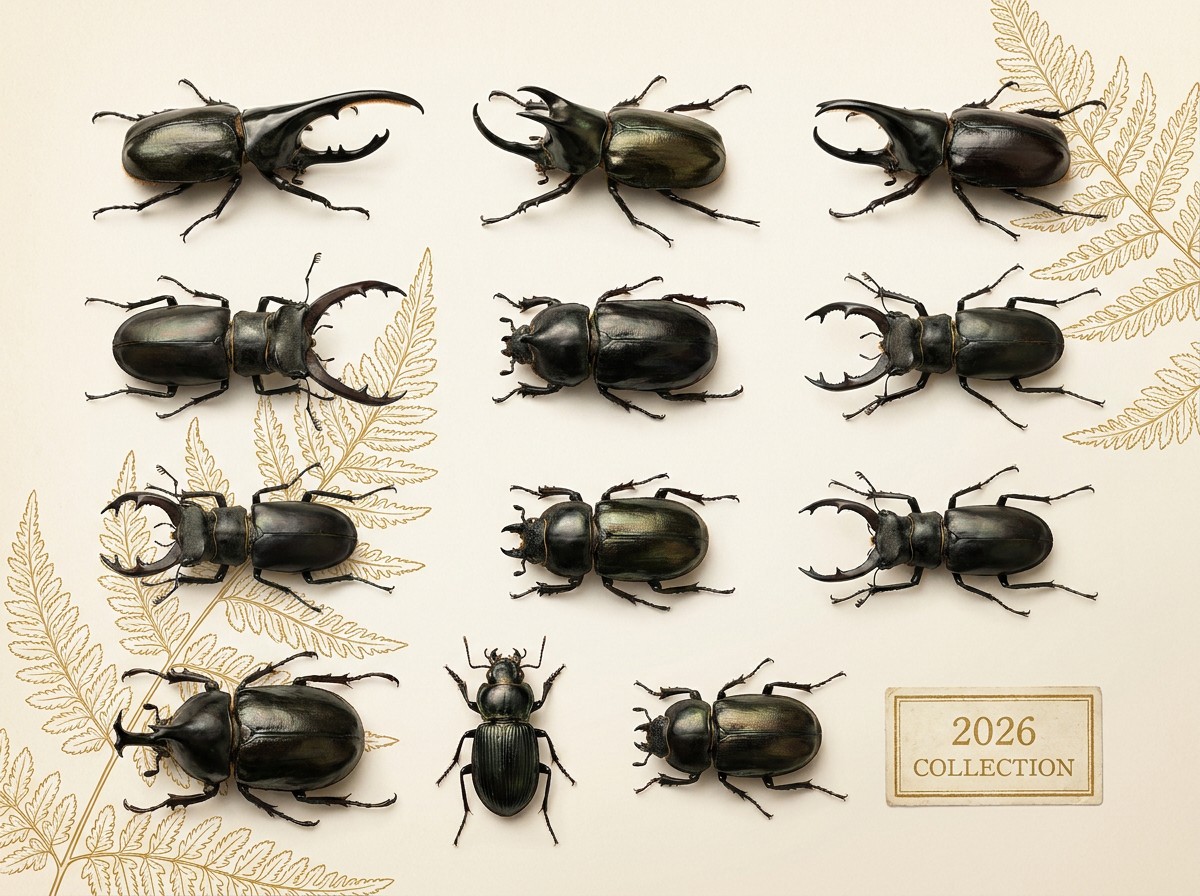
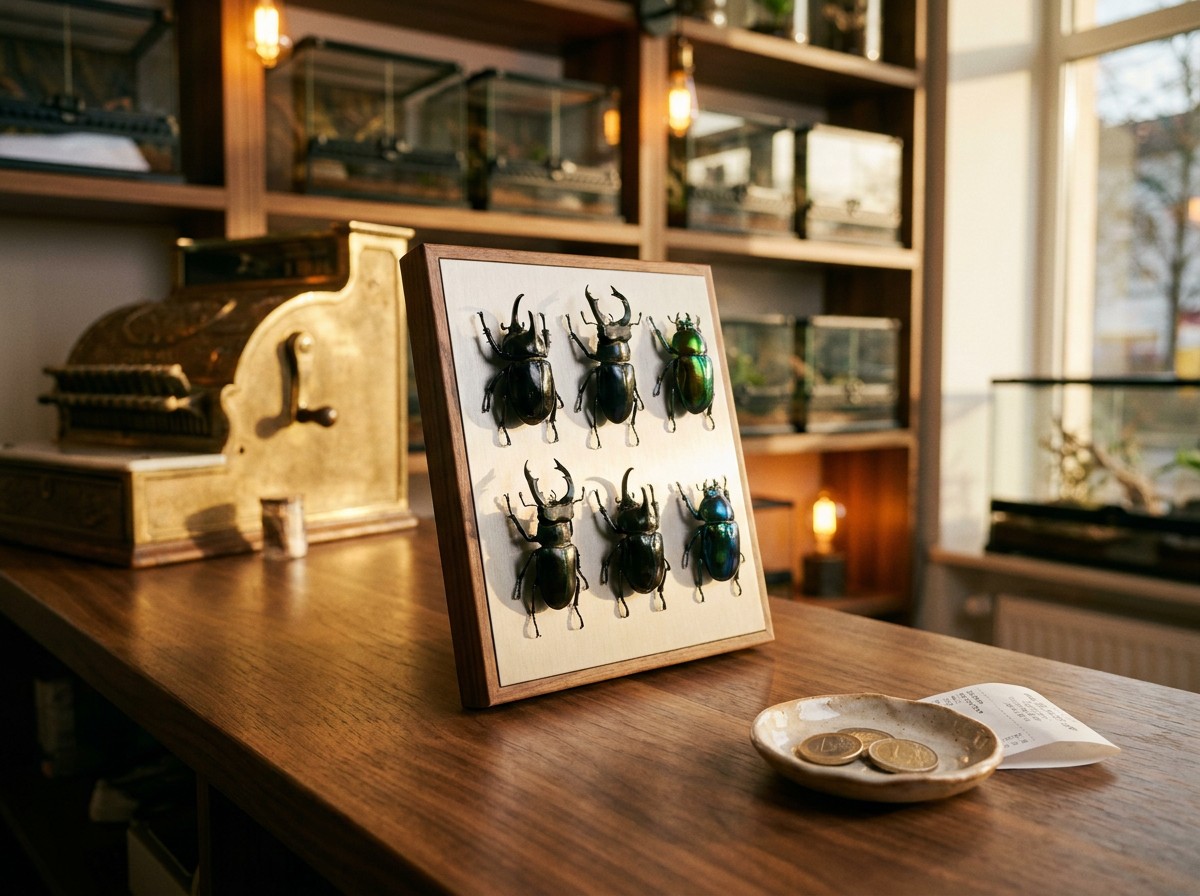
Beetles are among the most diverse animal groups on Earth. This field guide introduces fourteen species that inspired the shapes, colors and proportions of our 2026 hand-painted epoxy-resin refrigerator magnets. The products are fully artificial decorative replicas — no real beetle, preserved specimen, shell or exoskeleton is used.
Why Beetles Captivate Collectors
The fascination is not really about size, though many of these species are genuinely massive. It is about variation within a familiar form. Every species in this guide is recognizably a beetle — six legs, hardened wing cases (elytra), segmented body — and yet each one has evolved a wildly different solution to the same basic problems of survival and competition. Horns, mandibles, iridescent shells, metallic colors, saw-toothed jaws: each is a story about an evolutionary arms race in a specific corner of the world.
Collectors who fall in love with beetles rarely stop at one. The collection grows because each species is so visually different from the last. What follows is a tour through the fourteen species in our catalogue, ordered roughly by family and dramatic impact.
The Rhinoceros Beetles (Subfamily Dynastinae)
Rhinoceros beetles are the showstoppers of the beetle world. Males of nearly every species sport one or more curved horns extending from the head and thorax — used in head-to-head combat with rival males for access to mates and feeding sites. They are also among the strongest animals on Earth relative to body weight, capable of lifting 850 times their own mass.
Caucasus Beetle (Chalcosoma chiron belangeri)
The largest beetle in Asia and arguably the most iconic horned beetle in the world. The Indochinese subspecies grows to 130mm body length with a 109mm curved cephalic horn that gives the species its mythological name. Adults are jet black with a faint metallic sheen. Distributed across the Indochinese Peninsula — Thailand, Laos, Vietnam, Cambodia. Together with South America's Hercules Beetle, the Caucasus is considered one of the two most powerful beetles on Earth.
Borneo Caucasus Beetle (Chalcosoma mollenkampi)
Endemic to Borneo and one of the so-called "Three Musketeers of the South Seas" — a trio of Chalcosoma species prized by Asian collectors. The Borneo Caucasus is distinguishable by its narrower thoracic horn spacing and a cephalic horn with small denticles and a pair of rear protrusions. Body length reaches 125mm. A flagship species for Bornean entomological tourism.
Alcides Rhinoceros Beetle (Chalcosoma alcides)
The third member of the Chalcosoma trio, distributed across Malaysia, Brunei, Papua New Guinea, Borneo, and Indonesia. At 80mm body length, it is the smallest of the three but features the most architecturally striking horn morphology — a single tall cephalic horn with a tight inward curve. A favorite of collectors who prize form over size.
Sumatran Atlas Beetle (Xylotrupes sumatrensis)
Distributed exclusively on Sumatra Island, Indonesia. The Sumatran Atlas is one of the largest species in the Xylotrupes genus, reaching 85mm body length with a substantial 77mm horn. Males are notorious for their combat ability — pair two males with a single female and you will witness one of the more dramatic confrontations in the insect world. The elytra carry a faint metallic luster that gives the beetle a majestic presence in display.
Mars Elephant Beetle (Megasoma mars)
A prominent member of the Megasoma (elephant beetle) genus, distributed across Central and South America. Body length reaches 127mm with a 106mm forward-curving horn. Unlike most rhinoceros beetles, the Mars elephant has smooth, glossy black elytra rather than rough or textured wing cases. Famously easy to breed in captivity, which makes it both a collector favorite and a popular subject for entomology enthusiast communities.
Jason's Rhinoceros Beetle (Megaceras jason)
A well-known South American species in the Megaceras genus, distributed across Brazil, French Guiana, Venezuela, Ecuador, and Bolivia. At 82mm body length, it is on the smaller side for this catalogue but distinguished by an elegantly curved single horn and richly colored deep-purple iridescent elytra in mature males.
Trident Beetle (Beckius beccarii)
Found in Indonesia and Papua New Guinea. A medium-sized rhinoceros beetle whose name comes from its distinctive head architecture: two tooth-like thoracic horns combined with the cephalic horn form a shape resembling Poseidon's trident. Body length 91mm. The trident formation has made it one of the most photographed beetles in the South Pacific.
Rabbit-Ear Beetle (Eupatorus birmanicus)
Distributed across western Thailand and Myanmar. A medium-sized beetle (70mm body) with one of the most charming morphologies in the catalogue — the horn projections above the male's pronotum extend upward and curve gently, closely resembling rabbit ears. Despite its understated coloration, the rabbit-ear beetle has become a sentimental favorite among collectors who prize whimsy over raw drama.
Japanese Rhinoceros Beetle (Allomyrina dichotoma)
Distributed throughout China, Korea, Japan, and Southeast Asia. Commonly called the "unicorn beetle" for its single forward-projecting horn split into two prongs at the tip. Body length 84mm. The most culturally beloved beetle in East Asia — kept as a summer pet in Japanese households for centuries, featured in countless children's books and anime, and an entry point for many lifelong invertebrate enthusiasts.
The Stag Beetles (Family Lucanidae)
Stag beetles are the second great family of dramatic horned beetles. Where rhinoceros beetles grow horns from the thorax, stag beetles modify their mandibles — the jaws — into massive antler-like structures used both for male-male combat and for impressing females. The most extreme species have mandibles longer than their bodies.
Giraffe Sawtooth Stag (Prosopocoilus giraffa intermedia)
The world's longest stag beetle, and the world's longest sawtooth stag specifically. Distributed throughout Southeast Asia. Total body length reaches 118mm — but it is the 107mm mandibles, lined with sharp serrations like a steak knife, that earn the species its name. The giraffe sawtooth is one of three species (alongside the Palawan Giant Flat Stag and the Giant Mandible Stag) recognized as the world's three super-large stag beetles.
Giant Mandible Stag (Hexarthrius mandibularis)
Distributed in Indonesian Borneo and Sumatra Island. The defining feature is the wave-like undulation along the inner edge of its 99mm mandibles — unlike the straight or sawtoothed jaws of other stags. Body length 110mm. Few beetles photograph as dramatically as the Giant Mandible from a top-down angle.
Sumatran Giant Flat Stag (Dorcus titanus yasuokai)
Found on Sumatra Island. One of the world's largest flat stag beetles, with documented body lengths exceeding 105mm. The "flat" designation refers to the beetle's exceptionally low, broad body profile — built for combat rather than flight. Robust mandibles, a thick head and thorax, and an aggressive disposition make this species a heavyweight in the stag beetle world.
Dalmanni Stag Beetle (Odontolabis dalmanni intermedia)
Distributed across the Philippine islands. The largest of the Odontolabis stags at 111mm body length, with 98mm mandibles. Visually striking because of its dual-finish elytra — strongly glossed wing cases paired with a matte/frosted pronotum, giving the beetle a refined two-tone appearance that distinguishes it from the uniformly glossy stags of its family.
The Ground Beetles (Family Carabidae)
Decorse's Giant Ground Beetle (Crepidopterus decorsei)
The single non-horned beetle in this catalogue, included because it represents an entirely different evolutionary path to dramatic presence. Distributed in Madagascar. Body length 57mm — small by this catalogue's standards but exceptionally impressive in person because of its sturdy, plate-armored build and fierce mandibled face. Unlike rhinoceros and stag beetles, which are largely herbivorous, the Decorse's Giant Ground Beetle is a carnivorous insect, hunting other invertebrates on the Madagascar forest floor. A representative of Africa's monster-class ground beetles and one of the most internationally renowned species of the Anthiinae subfamily.
From Species Inspiration to Artificial Resin Collectible
Each product is a man-made beetle-inspired decorative magnet. The catalogue records the replica's finished dimensions and scientific reference, but those measurements describe the resin product rather than a preserved insect. Color and surface detail may vary slightly because the pieces are hand-finished.
The declared construction is hand-painted epoxy resin with magnetic backing. Buyers should confirm the selected model's material, dimensions, magnet attachment, packaging and labeling on the approved sample or quotation before publishing product claims in their own market.
Start Your Own Collection
The 2026 Beetle Magnet Collection catalogue presents fourteen hand-finished resin designs. Confirm each model's dimensions, material, magnet attachment, packaging, labeling, assortment minimum and customization feasibility on the current quotation before using product claims in a retail listing.
To explore the collection or request samples, reach out via WhatsApp or our contact form with the preferred designs, quantity and destination. We will confirm current pricing, availability, packing and the order-specific production estimate.